


How modern simulator technology can help golfers practice smarter, understand their swing and improve year round
For a long time, golf simulators were viewed mainly as entertainment. They were a fun way to play famous courses with friends when the weather outside was not cooperating. That is still a big part of the appeal, but modern simulator technology has changed what is possible indoors.
Today, a quality launch monitor can capture an incredible amount of information about what happens when the club meets the ball. Ball speed, launch angle, spin, club path, face angle, strike location and shot shape can all become part of the practice experience. That raises an interesting question for golfers who are considering a simulator. Can practicing indoors actually make you a better golfer outdoors?
From my own experience, the answer is yes, provided you use the technology the right way.
How accurate are modern golf simulators?
A good golf simulator is not simply making a guess about where the ball would have gone. The launch monitor measures what happens at impact and uses that information to reproduce the resulting ball flight.
Depending on the technology being used, the system can measure ball speed, launch direction, launch angle, spin, club speed, club path, face angle and a number of other important factors. If the face is open to the path, the ball flight reflects it. If the strike moves toward the heel, you can see the effect on speed, spin and direction. If you make a swing change that improves your contact, the numbers usually tell that story as well.
That is one of the things that makes simulator practice so useful. You are no longer relying entirely on how a shot felt. You can see the ball flight, look at the measurements and begin to understand why the ball did what it did.
Can a golf simulator really improve your game?
This is where my own relationship with golf simulators changed.
I have had a simulator for years, and in the beginning I used it much like most golfers probably would. I played virtual courses, hit balls and enjoyed having golf available at home. It was primarily another way to play the game.
As the technology improved, particularly when I started using more advanced launch monitor data and integrated swing cameras, the simulator gradually became something different. It became a place where I could actually study my golf swing.
Instead of hitting ball after ball and hoping something improved, I could experiment with a change and immediately see what happened. I could look at my club path, face angle, strike location, spin and dispersion. I could compare the numbers with video of the swing and start connecting what I was feeling with what was actually happening at impact.
That process changed the way I practiced.
Over time, simulator practice became an important part of lowering my own handicap and ultimately shooting personal best scores. The technology did not make the swing for me, and it certainly did not eliminate the need to get outside and play golf. What it did was make it much easier to understand my tendencies and work on them with purpose.
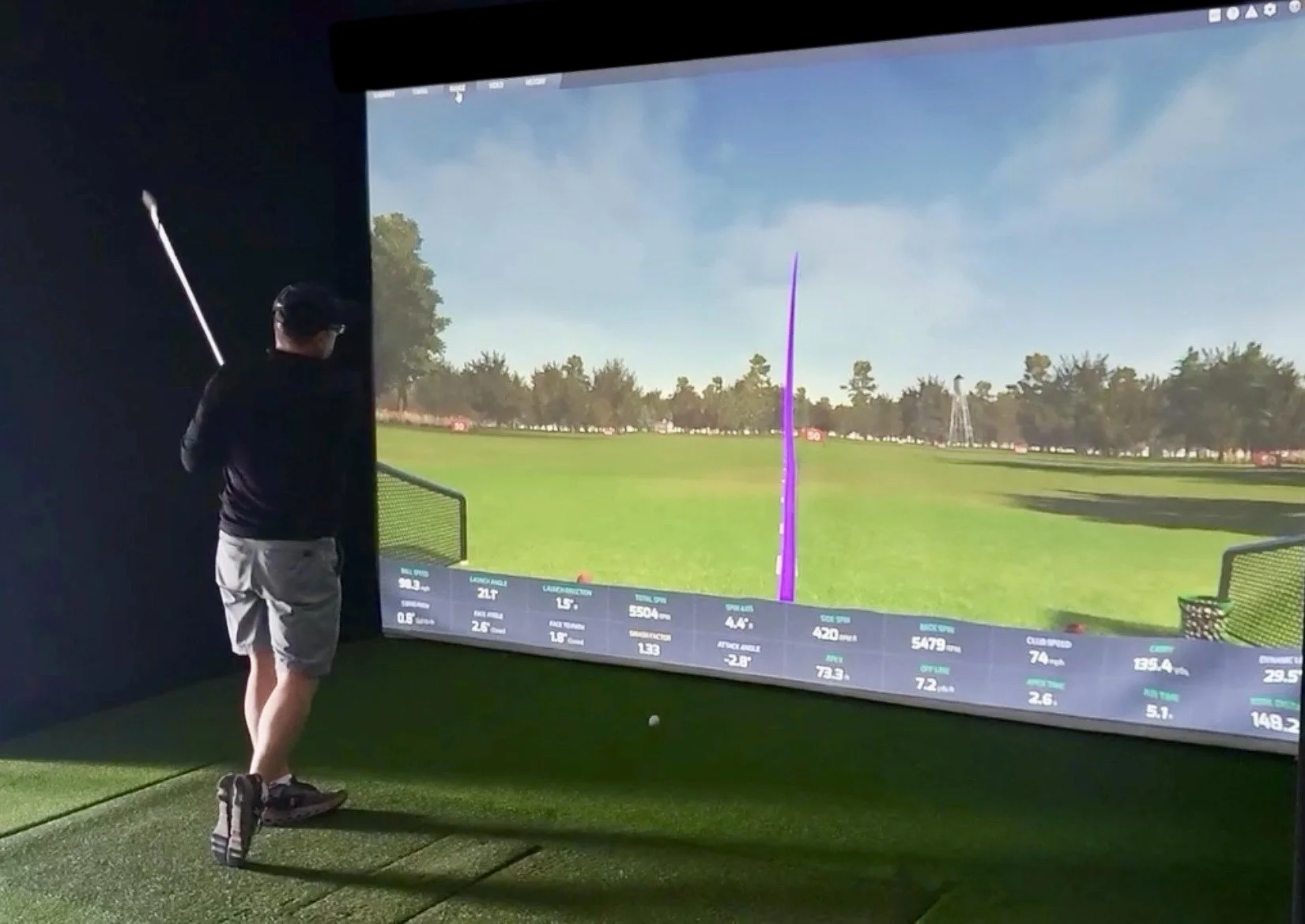 Indoor simulator practice provides immediate feedback on ball flight, launch data and swing performance, making every shot an opportunity to learn.
Every shot gives you information
One of the greatest advantages of simulator practice is the amount of feedback available after every shot.
On a traditional driving range, you can watch the ball fly and make a reasonable assessment of what happened. With a simulator, you can combine that ball flight with measurable information. You can see your carry distance, your dispersion, your spin and the relationship between the clubface and the swing path. With the right setup, you can also review your swing from multiple camera angles and study where the club contacted the ball.
There can be a temptation to become too focused on numbers, and I do not think that is the goal. The numbers are valuable because they help answer a very simple question. Why did the ball do that?
Once you begin to understand that relationship, practice becomes much more productive. Instead of simply hitting more golf balls, you start learning from them.
What a simulator cannot reproduce
As much as I believe in simulator technology, there are still parts of golf that are difficult to recreate indoors.
A real golf course gives you uneven lies, rough, changing turf conditions, wind, temperature, awkward stances and all the little variables that make golf such a difficult game. There is also the mental side of playing. A six foot putt on a simulator does not feel quite the same as a six foot putt that matters in a match. A drive on a virtual course does not create exactly the same feeling as standing on a tight tee with trouble on both sides.
Turf interaction is another important part of the game. Hitting from a level mat is different from hitting from real grass, particularly when you are learning how the club interacts with the ground.
For those reasons, I have never looked at simulator golf as a replacement for outdoor golf. I think the two work best together.
 The real test comes outside, where the swing developed through practice has to perform on the golf course.
Indoor and outdoor golf complement each other
The golf course has a way of exposing the parts of your game that need attention. The simulator then gives you a controlled environment where you can work on those areas.
If the driver starts getting inconsistent, you can hit a series of drives and look at the pattern instead of judging the swing from one or two shots. If a particular carry distance is giving you trouble, you can practice that number repeatedly. If you are trying to change your club path or improve your strike, you can make a swing, look at the result and make another adjustment almost immediately.
Then you take those changes back outside.
The golf course tells you whether the improvement survives real grass, uneven lies and the pressure of actually keeping score. What you learn on the course can then become the focus of your next indoor practice session.
For me, that relationship between indoor practice and outdoor golf is where simulator technology becomes especially valuable. The simulator gives you a place to measure, experiment and learn. The golf course gives you the ultimate test.
The Canadian advantage
For golfers in Canada, there is another obvious benefit. Our outdoor golf season simply does not last twelve months.
For much of the country, there can be a long gap between the final rounds of the fall and the first rounds of spring. Traditionally, that meant putting the clubs away for several months or finding an indoor range occasionally and hoping to keep some sort of swing going.
A home simulator changes that experience completely.
You can continue to swing throughout the winter. You can maintain your distances, work on changes, test equipment and play complete rounds. More importantly, you can continue learning about your game during months when outdoor practice might otherwise be impossible.
When spring arrives, you are not necessarily starting over.
That does not mean simulator golf removes the adjustment period that comes with getting back onto real turf, but it can keep the golf swing and the thought process around the game much more active throughout the winter.
Building the right simulator matters
The quality of the experience depends on much more than simply choosing a launch monitor.
Room dimensions, ceiling height, screen size, hitting position, projector placement, turf, lighting, computer performance, software and enclosure design all contribute to the finished simulator. When those pieces work together properly, the room begins to feel less like a collection of technology and more like a place to play golf.
That is a big part of what we focus on at SimCaddy.
Every space is different, and every golfer is looking for something slightly different from their simulator. Some people primarily want a place to practice and improve. Others want an entertainment space where they can play courses with friends and family. Many want both.
The goal is to build a system around the golfer, the room and the way the simulator will actually be used.
For me, that is ultimately why I have become such a believer in this technology. My simulator started as another way to enjoy golf at home. Over time, it became one of the most useful tools I have had for understanding my own game.
It did not replace playing golf.
It helped me become a better golfer.
About the Author
Tom Murray is the founder of SimCaddy, a Certified Technology Specialist (CTS), and a passionate golfer with a keen interest in golf technology and game improvement. Combining professional audiovisual design principles with real-world simulator experience, Tom helps golfers navigate the complexities of launch monitors, projection systems, simulator software, gaming PCs, and room design. Through SimCaddy, Tom focuses on helping golfers understand what is possible and creating simulator experiences that deliver lasting value.
Share:
Golf Simulator Projectors Explained
Building a 4K-Optimized Golf Simulator