Why Simplicity Improves Indoor Golf Training
Discover why simplicity and a neutral baseline make golf simulation more effective, more natural, and better for real world golf improvement.
Indoor golf has transformed how many of us practice, train, and enjoy the game. For me personally, simulator technology, particularly systems like the ProTee VX and ProTee Labs, has played a major role in my improvement. Studying swing mechanics, understanding ball flight physics, and using performance data helped me become a more consistent ball striker and a more analytical student of the game.
As someone who designs and supplies golf simulator systems across Canada, I also get to see how impactful indoor golf can be for players of all skill levels. Simulators provide year round access, consistent conditions, and meaningful feedback, benefits that simply did not exist at this level a decade ago.
Yet despite all this progress, one area of simulator golf still stands apart: putting.
Simulator Putting Has Improved and It Can Be Fun
To be clear, I am not anti simulator putting.
Just recently, I was on my ProTee VX using gaming software, rolling 40 to 45 foot putts with noticeable break, over and over, simply for fun. I knew it was not perfectly realistic, but it was close enough, immersive, and enjoyable. And that matters. Simulator golf should be fun.
Putting simulation has come a long way. Ball tracking, roll physics, green visuals, and depth perception have all improved significantly in recent years. Companies are investing heavily in this area, and the pace of development is impressive.
But even with that progress, putting remains the most difficult part of indoor golf to truly replicate.
Why Putting Is So Hard to Simulate Indoors
Putting exists in an incredibly narrow performance window. Tiny changes in face angle, strike location, and ball speed can dramatically change outcomes. Add in slope, surface friction, grain, moisture, and visual perception, and you begin to appreciate just how complex real world putting truly is.
Trying to recreate all of this digitally inside a controlled indoor environment is extremely difficult.
That is why different platforms handle putting differently. Detection zones vary. Ball speed thresholds differ. Green physics behave inconsistently. The result can be a putting experience that feels convincing and fun but not always predictable or consistent for serious training.
Indoor Golf Represents Every Golfer’s True Baseline
One of the most overlooked truths about indoor golf is that it represents every golfer’s purest baseline.
Indoors, we all practice in the same conditions. Zero wind. Stable temperature. No moisture. Flat, level surfaces. Consistent footing.
This is the most neutral environment golf can offer.
It allows players to isolate their mechanics, understand their tendencies, and receive clean, undistorted feedback. This is exactly why launch monitors and simulator data are so powerful indoors. Environmental noise is removed, letting golfers focus entirely on their own performance.
That is also why introducing artificial outdoor variables indoors can sometimes feel unnatural. When your body feels still air and flat ground, but the software introduces wind or exaggerated slopes, there is a subtle disconnect. It does not ruin the experience, but it can make training feel less intuitive.
For many golfers, simplicity builds trust.
My Personal Baseline: Start the Ball on a Straight Line
For my own putting, I keep things very simple.
It is all about starting the ball on a straight line.
Everything else, speed, break, uphill, downhill, is dictated by reads. But none of that matters if you cannot consistently start the ball where you intend. So indoors, on a flat surface, if I can groove a repeatable stroke that sends the ball down my chosen line, I am working on the most important part of putting.
That flat indoor floor becomes my true baseline.
No wind.
No slope.
No variables.
Just me, the putter, and a straight roll.
If I can build confidence in my ability to start the ball on line, everything else becomes easier once I step back onto real greens. Reads change. Conditions change. Start line does not.
Where Simplicity Helps Most: Putting
This philosophy matters most when it comes to putting.
Rather than forcing complex digital green contours into a space that physically cannot replicate them, many golfers and leagues choose a simpler approach, including gimmes inside six or seven feet. That is not cheating. It is a practical acknowledgment of current technological limits, and it keeps play enjoyable, fair, and consistent.
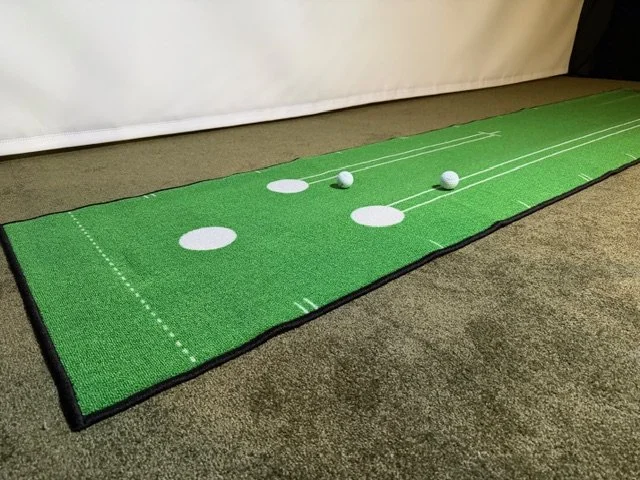
For training, I often use my simulator putting for distance feel, start line practice, and entertainment. When I want to sharpen my putting most effectively, I turn to a simple putting mat and focus on face control, tempo, and rhythm.
That balance has worked extremely well for me.
Simulator putting is excellent for fun and immersion. Real putting surfaces remain the gold standard for technical development.
A Standout Experience: Golfzon City Golf
One of the most impressive putting experiences I have seen came from Golfzon City Golf at the 2026 PGA Show.
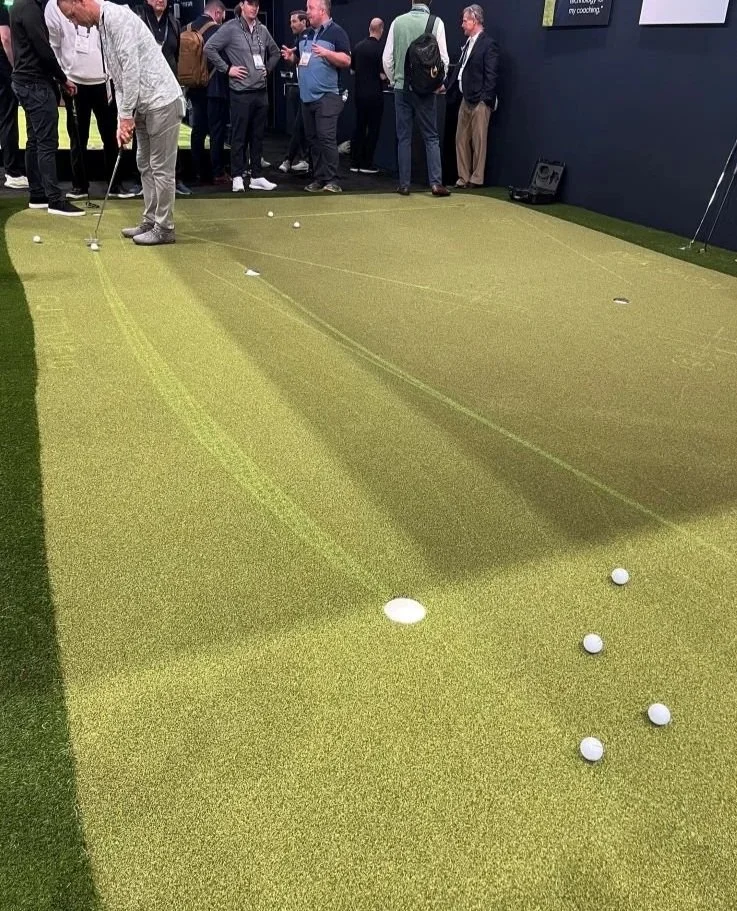
Once you reach the fringe, the simulator screen lifts and you step onto a real physical putting surface. You are suddenly reading real slopes, standing on real turf, and rolling a real ball toward a real cup.
Not only was this incredibly cool, it also felt like a smart hybrid approach to indoor golf. Instead of forcing simulation to do everything, Golfzon allowed physical reality to handle what it does best.
It was immersive, intuitive, and far closer to real putting than anything I have experienced on a screen alone. That experience stayed with me because it showed that sometimes better design beats more software.
Progress Is Real and Encouraging
The most exciting part is that this space is moving quickly.
Companies like ProTee, Foresight, Golfzon, and PuttView continue to push innovation forward. Camera technology, tracking accuracy, and physics modeling improve year after year. The experience today is dramatically better than it was even five years ago.
That progress deserves recognition.
At the same time, it is fair to say we are still in the middle of that journey, especially when it comes to putting.
Finding the Right Balance
Indoor golf does not need to perfectly replicate outdoor golf to be effective.
Its true strength lies in consistency, repeatability, accessibility, and year round training.
Putting will always be one of the hardest elements to simulate, but thoughtful design, simplicity, and hybrid approaches can make the experience more intuitive, more enjoyable, and more effective.
The goal is not perfection.
It is progress.
And from what I am seeing, we are heading in the right direction.
Tom Murray is the Founder and President of SimCaddy, a golf simulator design and supply company serving customers across Canada. As a CTS-certified audiovisual professional, Tom combines his AV expertise with a passion for golf simulators, specializing in designing and building advanced systems for both residential and commercial spaces. His focus is on delivering immersive, high-quality solutions tailored to each client’s unique needs.