
The Truth About Indoor Golf Turf
What golfers need to know about club-turf interaction when practicing on hitting mats and indoor golf simulators.
Indoor golf simulators have transformed how golfers train. What was once available only to touring pros and high-end teaching studios is now accessible to everyday players in their own homes. Launch monitors offer precise data, high-speed cameras reveal nuances in movement, and controlled environments allow for focused repetition year-round. But for all this technology, one element of indoor golf remains fundamentally different from outdoor golf: the turf. How the club interacts with the surface beneath the ball influences everything about contact, compression, and swing mechanics. Understanding this difference is essential for any golfer who wants indoor practice to translate to the course.
Why Real Turf and Hitting Mats Behave Differently
Outdoors, grass and soil work together to create a predictable interaction when the club enters the ground. Turf scientists describe this as shear strength, the ability of the ground to tear, displace, and absorb the leading edge of the club. A real divot is not just a result of “hitting down”; it is the ground yielding in a way that supports the club’s movement. Indoors, synthetic turf cannot replicate this dynamic. Mats don't shear or displace. Instead, they resist, grip, and rebound. This means the clubhead behaves differently on imperfect strikes, and golfers quickly feel the difference when the leading edge meets a surface that doesn’t give.
What Coaches and Data Experts Say
Instructional experts have acknowledged this for years. Trackman has noted in its education materials that mats can sometimes mask fat shots because the club skids or bounces into the ball rather than digging and slowing as it would in real turf. GOLFTEC has also spoken publicly about how mats can encourage golfers to pick the ball cleanly, since steep contact feels harsher and leads to immediate feedback that the body naturally avoids. Even engineers who design indoor hitting surfaces describe mats as approximations of fairway turf (not true replicas) because replicating the behaviour of soil and grass indoors is physically impossible.
How Hitting Mats Influence Your Swing Mechanics
This difference in surface interaction often leads to subtle changes in swing mechanics. Because taking a divot indoors produces sharper feedback, indoor golfers naturally begin adopting a shallower approach that minimizes turf contact. This instinctive adjustment often results in cleaner, more efficient strikes indoors, and it provides clearer feedback when you achieve proper low-point control. But it also represents a shift away from the swing dynamics many players use outdoors, where the turf absorbs the blow and releases the club more naturally.
Indoor practice can also create more physical strain than golfers realize. Because mats do not allow the club to move through the turf naturally, the impact forces return to the hands, wrists, and forearms more abruptly than they do on real grass. Combined with the faster pace of simulator sessions (where golfers often hit far more balls in less time) fatigue can build quickly. It’s something to be mindful of during extended practice. (Related: Choosing the Right Hitting Strip)
One Underrated Perk of Indoor Golf: No Divots to Repair
Despite these limitations, indoor practice can sharpen ball-striking in valuable ways. Because mats cannot produce true divots, the only way to achieve meaningful compression indoors is through pure, ball-first contact. Indoors, slight errors in low-point control become quickly apparent. Good strikes feel unmistakably crisp. The environment rewards precision, which can help golfers refine their ball-striking in ways that complement outdoor play.
It’s also worth noting that even the best ball-strikers in the world often take far smaller divots than golfers imagine. A well-known exchange between Scottie Scheffler and Tiger Woods illustrates this perfectly. Scheffler observed that Tiger barely disturbed the turf when hitting irons. Tiger explained that during his best golf, he rarely took noticeable divots because he was striking the ball so purely that the club simply brushed the ground after impact. While few golfers can replicate Tiger’s level of precision, the principle is universal: compression comes from clean contact and precise low-point control, not from tearing up large divots.
What TGL’s Real-Turf Approach Tells Us
Professional golf is acutely aware of how important natural turf interaction is. The new TGL league could have designed any indoor hitting system imaginable. Instead, they chose to install real, live turf for players to hit from, allowing for genuine divot-taking and authentic impact dynamics. Their decision underscores how different the experience is on synthetic mats and how essential real turf can be for elite performance.
Aligning Expectations for Better Indoor and Outdoor Golf
None of this means indoor golf is less valuable. In fact, it may be one of the most powerful tools available to modern golfers. The consistency, the data, and the ability to isolate swing variables create an environment ideally suited for refining technique. But indoor practice is most effective when expectations are aligned with reality. Mats reward precision differently than real turf. They change the feedback the club gives you. They influence swing tendencies. And they cannot fully replicate the complex physics of grass and soil.
When golfers understand these differences, they can use indoor practice to build the mechanics they need while relying on outdoor golf to test those mechanics in real-world conditions. Indoor golf builds precision. Outdoor golf builds adaptability. Aligning those two environments, rather than assuming they behave the same, is the key to meaningful improvement.
Tom Murray, is the Founder and President of SimCaddy, a golf simulator design and supply company serving customers across Canada. As a CTS-certified audiovisual professional, Tom combines his AV expertise with a passion for golf simulators, specializing in designing and building advanced systems for both residential and commercial spaces. His focus is on delivering immersive, high-quality solutions tailored to each client’s unique needs.
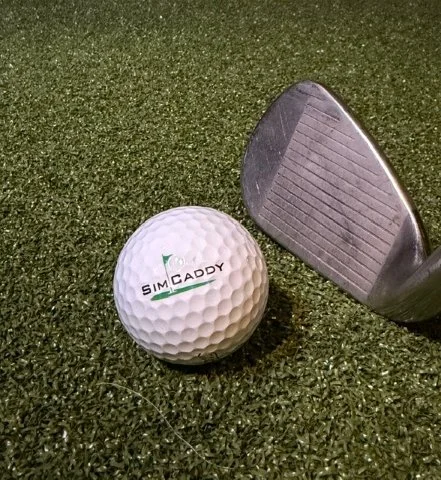
Indoor turf provides consistency and feedback, but the club–turf interaction is fundamentally different from real grass.
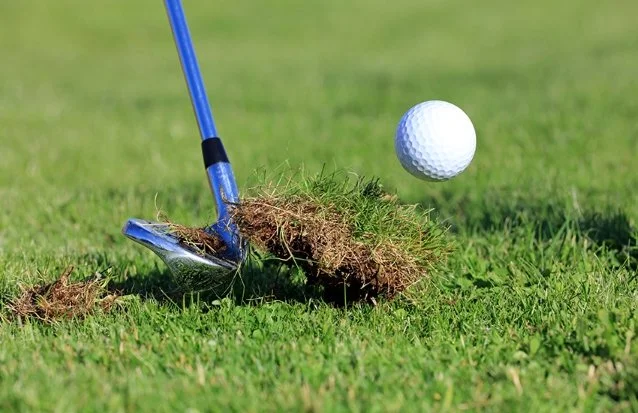
Natural turf absorbs and redirects the club in ways synthetic mats simply can’t.
Tiger tells Scottie his pure strikes don’t require divots.
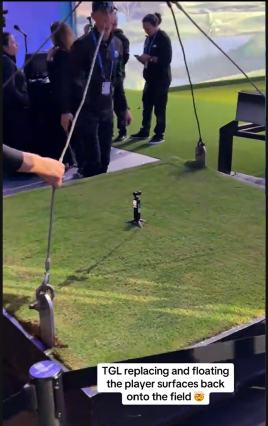
TGL crews install fresh real turf to ensure authentic divot-taking conditions.